
North America / USA
Denali National Park
One road enters an immense Alaskan wilderness of grizzlies, caribou, tundra, glaciers, and North America's highest mountain.
Trip fit
Is Denali National Park right for your trip?
Best for
Can I realistically visit this?
Yes, if you plan around the short season and park access rules. Denali is accessible but vast, weather-dependent, and not a place where mountain views are guaranteed.
Physical difficulty
Easy to strenuous, depending on activity
Planning complexity
Needs some planning
Best time to go
Best: Jun-Aug. Good: May, Sep. Closed / limited access: Oct-Apr.
Perfect for
- Wildlife watchers, mountain photographers, hikers, road-trippers, and travellers who enjoy big wilderness with structured access
Not ideal if
- Visitors who need guaranteed views of Denali or who dislike cold, rain, mosquitoes, and variable weather
Compare with similar places
Denali vs Kamchatka vs Southern Patagonia - huge northern or southern wilderness landscapes with serious weather.
Location
Where this place is
Denali National Park is in USA / North America, useful for dramatic landscapes, wildlife and photography before you choose routes, bases, and timing.
USA / North America
Open location on Google Maps opens in a new tabRegional orientation only. Open Google Maps for exact location.
Travel essentials
Before you book the flight
Do you need a visa for USA?
Start with the country visa-policy overview, then confirm current rules with an official source before booking.
Check visa requirements before booking
Start with the visa-policy overview, then confirm the current rules with an official embassy, consulate, or government source before booking non-refundable travel.
If using a visa service, compare processing times, fees, refund rules, and whether they cover your nationality.
Optional visa service comparison opens in a new tab- 1 EUR ≈ 1.14 USD
- 1 GBP ≈ 1.34 USD
Exchange Rates Updated Daily. Last updated on 19/Jul/2026.

Big Mac® benchmark: approx. 6.12 USD
Checked: January 2026. Prices vary by city and branch.
Approximate McDonald’s Big Mac® price where available. Prices vary by city, branch, tax, delivery channel, and date checked. This site is not affiliated with or endorsed by McDonald’s.
Source: The Economist Big Mac Index country-level data
Country-level Big Mac price from The Economist Big Mac Index
Prices Researched at May 2026
Where to stay
8+ rated stays for Denali National Park
Booking.com opens with an 8+ guest-score filter for Denali National Park, so you can compare current hotel photos, availability, prices, and recent traveler reviews before choosing a base.
8+ guest review score on Booking.com

Country guide for the United States routed through its biggest, wildest national park.
Why it is beautiful
Denali National Park contains North America’s highest mountain (6,190 m) at the centre of 24,000 square kilometres of sub-arctic wilderness — a space so vast it has only one road and is more than large enough to hold grizzly bears, wolves, moose, caribou, and Dall sheep in genuinely open country. Denali itself is covered in cloud roughly 70% of the time, which makes a clear day feel like something earned rather than simply observed. The park’s single road goes further into wilderness than almost any equivalent road in North America, and the design of the whole place — limited vehicles, hop-on/hop-off buses, off-trail tundra walking — keeps the sense of scale intact. The pull here is the sense of wild scale, not a checklist of attractions.
10 practical tips to help you decide
These tips are designed to help you decide whether Denali National Park fits your time, budget, comfort level, and travel style.
-
For wildlife watchers, wilderness hikers, and mountain photographers — not those who need guaranteed views or predictable weather. Denali suits travellers who want big Alaskan wilderness: grizzlies in open tundra, caribou herds, a mountain that changes every hour, and a park large enough to absorb every visitor. Skip it if you need a clear summit view to feel the trip was worth it — Denali is in cloud most days, and the park experience is far more than the peak. Cold, rain, and mosquitoes are part of the deal.
-
June to late August for the main season. Late August–September for fall colours and wildlife photography. Mid-May to mid-September is the operational window; outside that, most services and campgrounds close. Late June and July bring 20+ hours of daylight, warm temperatures, and wildflowers — also the peak mosquito season. Late August and early September deliver fall colours on the tundra, the bull moose rut, caribou herd movements, and the first possibility of aurora viewing. September also offers shorter queues and cheaper accommodation outside the park.
-
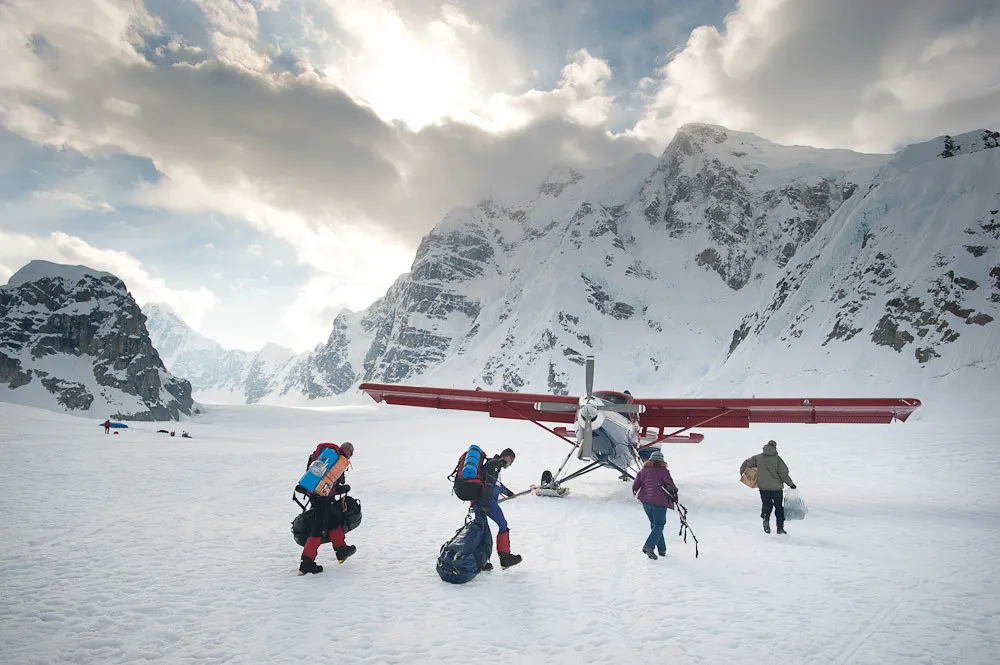
Fly into Anchorage, then drive or take the Alaska Railroad to the park. Anchorage (ANC) is the standard gateway — 4 hours north on the Parks Highway (AK-3). The Alaska Railroad’s Denali Star (8 hours from Anchorage, glass-domed cars) is the scenic alternative for those without a rental car. Stop in Talkeetna, 2.5 hours south of the park, for flightseeing over Denali — on a clear day, glacier-landing packages from operators like K2 Aviation or Talkeetna Air Taxi (~USD 400–500 per person) deliver a view the road cannot match. Visa Waiver Program visitors need an ESTA at esta.cbp.dhs.gov (USD 21, valid 2 years) — apply before departure.
-
Two to four days is the recommended stay. Build in a buffer for weather. Two full days gives a wildlife bus trip and one marked hike. Three to four days opens a backcountry overnight, a second bus day, and the flexibility to wait out cloud cover for a clear-sky morning. Denali’s weather is genuinely variable — without a buffer day, the mountain may stay hidden your entire visit. Most visitors find three nights is the minimum for a satisfying experience.
-
Book bus tickets and campground reservations early — both sell out well ahead of peak season. Private vehicles are restricted to the first 15 miles of the park road (to Savage River). Beyond that, the park’s transit buses (USD 39 round-trip, hop-on/hop-off) are the only access. The 2021 Pretty Rocks Landslide cut the road at Mile 43; check the Denali NPS website for the current road-access status before booking, as bridge replacement work is ongoing. Campground reservations open in February and fill for the peak summer months. Reservations are through recreation.gov.
-
Campgrounds, entrance-strip lodges, and remote backcountry camps — choose by experience level. Six campgrounds operate inside the park; only Riley Creek has electrical hookups. Backcountry permits are free (with required bear-canister rental) and are the deepest Denali experience. Grande Denali Lodge and McKinley Chalet near the entrance are reliable mid-range. Kantishna backcountry lodges (Camp Denali, Denali Backcountry Lodge) are currently fly-in only while road access beyond Mile 43 remains closed. Budget stays in Talkeetna are a good-value alternative base.
-
Park entry is USD 15 per person; total trip costs run higher. The 7-day park pass is USD 15 per person; the America the Beautiful annual pass (USD 80) covers all US national parks for a year and pays off after two or three parks. Transit bus tickets, flightseeing, and accommodation push daily costs significantly. A 3-day budget including entrance, buses, one campground night, and meals runs USD 150–250 per person per day. Flightseeing is the highest single-value addition — save for it on a clear-sky day.
-
Bears are present throughout — backcountry regulations are mandatory, not optional. Grizzly bears and black bears are both present. Bear canisters are required for all backcountry use and are available to rent at the visitor centre. Secure all food and scented items at frontcountry campgrounds too. Moose cause more NPS visitor injuries than bears — give them wide berth at all times. Wildlife viewing is usually from the bus or while off-trail tundra walking; keep the required 300-yard distance from bears and wolves and 25 yards from other animals.
-
Off-trail tundra walking is the park’s primary hiking mode — there are very few marked trails. Denali intentionally has fewer marked trails than almost any comparable US national park. Hop off the transit bus at any stop and walk open tundra. The main marked routes near the entrance are Savage Alpine Trail, Mount Healy Overlook, and Triple Lakes Trail. For backcountry trips, register at the visitor centre, carry a bear canister, and download offline topo maps — cell coverage is non-existent beyond the entrance.
-
Denali is the centrepiece of a two- to three-week Alaska circuit. A practical Alaska sequence: Anchorage (1 day) → Kenai Peninsula and Kenai Fjords National Park (3–4 days, day cruise from Seward) → Talkeetna flightseeing (1–2 days) → Denali (3–4 days) → Fairbanks and optional Arctic Circle day trip (2–3 days). Fairbanks in September adds the strongest aurora-viewing window. The full circuit takes 12–16 days and covers Alaska’s main zones: ocean, temperate rainforest, sub-arctic tundra, and mountain wilderness.