
Middle East / United Arab Emirates
Sheikh Zayed Grand Mosque
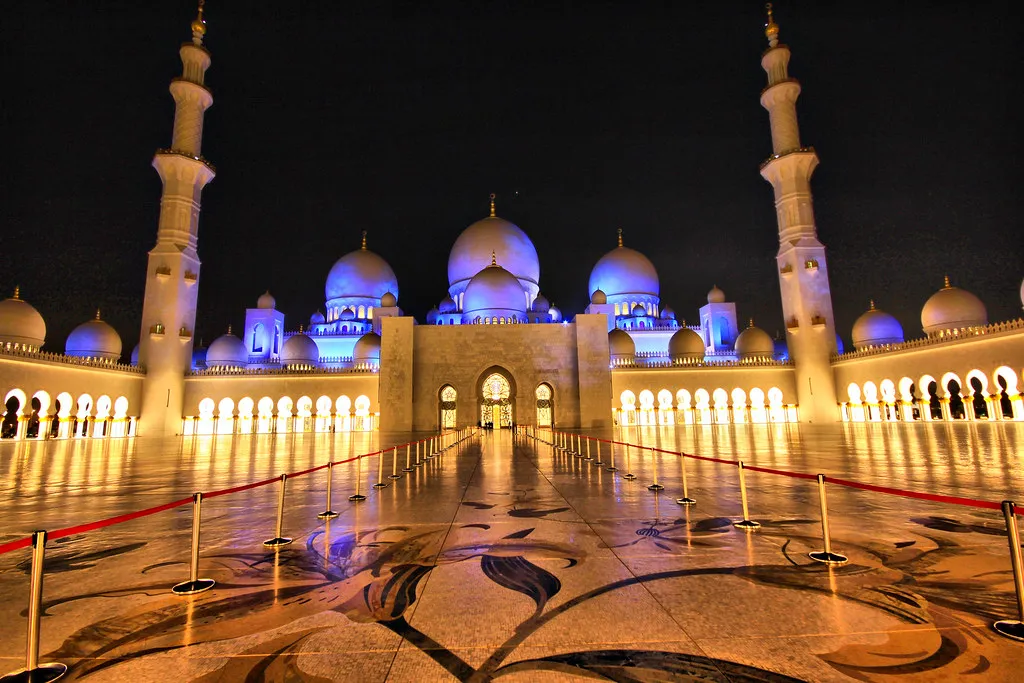
Marble courtyards, domes, columns, and reflective pools make Abu Dhabi's great mosque glow with serene scale.
Trip fit
Is Sheikh Zayed Grand Mosque right for your trip?
Best for
Can I realistically visit this?
Yes. It is very accessible from Abu Dhabi and often possible from Dubai, but timing, dress code, heat, and visitor rules matter. It is best experienced with enough time for both detail and scale.
Physical difficulty
Easy
Planning complexity
Easy independent trip
Best time to go
Best: Nov-Mar. Good: Apr, Oct. Very hot: May-Sep.
Perfect for
- Architecture photographers, families, first-time UAE visitors, and travellers wanting a high-impact cultural landmark
Not ideal if
- Visitors who ignore dress requirements, heat, or religious-site etiquette
Compare with similar places
Sheikh Zayed Grand Mosque vs Taj Mahal vs Sultan Ahmed Mosque - light stone, symmetry, devotion, and visual grandeur.
Location
Where this place is
Sheikh Zayed Grand Mosque is in United Arab Emirates / Middle East, useful for culture and architecture, photography and easy luxury trips before you choose routes, bases, and timing.
United Arab Emirates / Middle East
Open location on Google Maps opens in a new tabRegional orientation only. Open Google Maps for exact location.
Travel essentials
Before you book the flight
Do you need a visa for United Arab Emirates?
Start with the country visa-policy overview, then confirm current rules with an official source before booking.
Check visa requirements before booking
Start with the visa-policy overview, then confirm the current rules with an official embassy, consulate, or government source before booking non-refundable travel.
If using a visa service, compare processing times, fees, refund rules, and whether they cover your nationality.
Optional visa service comparison opens in a new tab- 1 EUR ≈ 4.20 AED
- 1 USD ≈ 3.67 AED
- 1 GBP ≈ 4.94 AED
Exchange Rates Updated Daily. Last updated on 19/Jul/2026.

Big Mac® benchmark: approx. 19 AED
Checked: January 2026. Prices vary by city and branch.
Approximate McDonald’s Big Mac® price where available. Prices vary by city, branch, tax, delivery channel, and date checked. This site is not affiliated with or endorsed by McDonald’s.
Source: The Economist Big Mac Index country-level data
Country-level Big Mac price from The Economist Big Mac Index
Prices Researched at May 2026
Where to stay
8+ rated stays for Sheikh Zayed Grand Mosque
Booking.com opens with an 8+ guest-score filter for Sheikh Zayed Grand Mosque, so you can compare current hotel photos, availability, prices, and recent traveler reviews before choosing a base.
8+ guest review score on Booking.com

Why it is beautiful
The Sheikh Zayed Grand Mosque was completed in 2007 after 12 years of construction and is one of the largest mosques in the world — the main prayer hall alone holds 7,000 worshippers, with the broader complex accommodating 41,000. It was built from white Macedonian marble inlaid with semi-precious stones, its 82 domes rising above a courtyard floor that is itself the world’s largest marble mosaic. The reflective pools around the courtyard mirror the white domes in still blue water, and at blue hour — the 20 minutes after sunset — the illuminated marble turns from cream to a warm gold before the colour-changing LED exterior lighting shifts through pale blues and greens. The mosque is an active place of worship and a public architectural landmark simultaneously, and the combination of extraordinary building and genuine religious function gives it a weight that purely tourist monuments lack.
10 practical tips to help you decide
These tips are designed to help you decide whether Sheikh Zayed Grand Mosque fits your time, budget, comfort level, and travel style.
-
For architecture photographers, families, and first-time UAE visitors who want a high-impact cultural landmark — not those who ignore dress requirements or religious-site etiquette. The mosque is free, open to non-Muslim visitors outside prayer times, and one of the most accessible major Islamic sites in the world. The dress code is strict and non-negotiable. Treat it as a sacred site first and an architectural wonder second and the visit is one of the Gulf’s best experiences.
-
November to March for comfortable outdoor temperatures and evening photography; avoid summer. Abu Dhabi in June to September regularly exceeds 40°C with high humidity — the marble courtyard has no shade and the heat makes extended visits difficult after 9am. October and April are transitional and manageable. November to March is the UAE’s winter: warm (22–28°C), clear, and excellent for the blue-hour photography that gives the mosque its most distinctive images. Plan to arrive mid-afternoon, stay through sunset, and leave after blue hour.
-
Abu Dhabi is 90–150 minutes from Dubai by road — often done as a day trip. The mosque is off the main Abu Dhabi highway, 20 minutes from Abu Dhabi city centre and 110 km from central Dubai. Taxis and organised day trips run from Dubai regularly. If staying in Abu Dhabi, all hotels are within 30–45 minutes by taxi. No public bus stops directly at the mosque — taxis or rideshare (Careem operates in Abu Dhabi). The UAE gives 30-day visa-free entry to most Western nationals on arrival; check the UK FCDO UAE travel advice for current entry requirements.
-
Half a day is sufficient for the mosque; extend to one or two days to add Abu Dhabi’s other cultural sites. Allow 2–3 hours for a thorough visit: entry queues, the courtyard, the prayer hall interior, and the detail of the inlaid stonework. A full half-day covers this at a relaxed pace. Adding the Louvre Abu Dhabi (10 minutes by taxi, one of the world’s great art museums) and the Qasr Al Watan presidential palace makes a full Abu Dhabi cultural day. Combining this with a stopover at Abu Dhabi airport (AUH) makes logistical sense for some itineraries.
-
No hotel stay is required — the mosque works as a day trip from Dubai or as part of an Abu Dhabi night stop. If staying in Abu Dhabi, the area near Abu Dhabi Corniche or the city centre offers mid-range to luxury hotels with easy taxi access to the mosque. Staying in Dubai and doing a day trip is the most common approach: leave Dubai at 2pm, arrive at the mosque at 4pm, photograph through blue hour, and return. If staying overnight in Abu Dhabi, it allows a calmer, less rushed visit and the opportunity to do the early-morning shift when the mosque is nearly empty.
-
Entry is completely free for non-Muslim visitors — one of the Gulf’s best-value cultural experiences. Admission is free. Guided tours are available and free (check current schedule at szgmc.gov.ae). Women are provided an abaya (full-length robe) and headscarf at the entrance at no charge. The mosque’s gift shop has high-quality printed reproductions of its artworks. There are no facilities on-site, though the complex has restrooms and an information centre. Budget for taxis to and from the mosque.
-
Dress code is mandatory and non-negotiable — prepare before arrival. Women must cover hair, arms, and legs — an abaya and headscarf are provided at the entrance if you arrive without. Men must wear long trousers and covered shoulders. Shorts, sleeveless tops, and revealing clothing require covering or you will be turned away. Bare feet are required inside the prayer hall (shoes are removed and stored). The dress code applies to visitors regardless of faith or nationality. Arrive dressed appropriately rather than relying on the provided coverings.
-
Visit on a Thursday or Friday evening for the largest illumination and the most atmospheric setting. The mosque is busiest on weekends (Friday in the UAE is the Islamic holy day) but also most alive — the Friday prayers draw thousands of worshippers and the post-prayer atmosphere is distinctive. Evening visits Thursday and Friday see more dramatic illumination sequences. The mosque is closed to non-Muslim visitors during prayer times; check the current schedule at szgmc.gov.ae before planning your arrival time.
-
The prayer hall interior is the architectural centrepiece — do not leave without entering. The main prayer hall holds the world’s largest hand-knotted carpet (5,627 square metres, made in Iran by 1,200 weavers over two years) and seven Swarovski crystal chandeliers, the largest of which weighs 12 tonnes. The ceiling is gilded arabesque plasterwork. Non-Muslim visitors may enter outside prayer times dressed appropriately. Remove shoes before entering and maintain quiet — it is an active place of worship. The transition from the marble courtyard to the interior is one of the most dramatic in Islamic architecture.
-
Combine the mosque with the Louvre Abu Dhabi for a full cultural day in the UAE. The Louvre Abu Dhabi, designed by Jean Nouvel on Saadiyat Island (10 minutes from the mosque), has a rainforest-of-light dome that produces the same kind of dappled illumination as the mosque’s reflective pools — two buildings of extraordinary light in a single day. The Louvre holds a genuinely world-class cross-cultural collection (early Islamic art, ancient Mediterranean civilisations, and modern works) at AED 63 (approximately USD 17) entry. Together, these two buildings make Abu Dhabi’s Saadiyat cultural district one of the most impressive cultural clusters built in the 21st century.