
South America / Bolivia
Salar de Uyuni
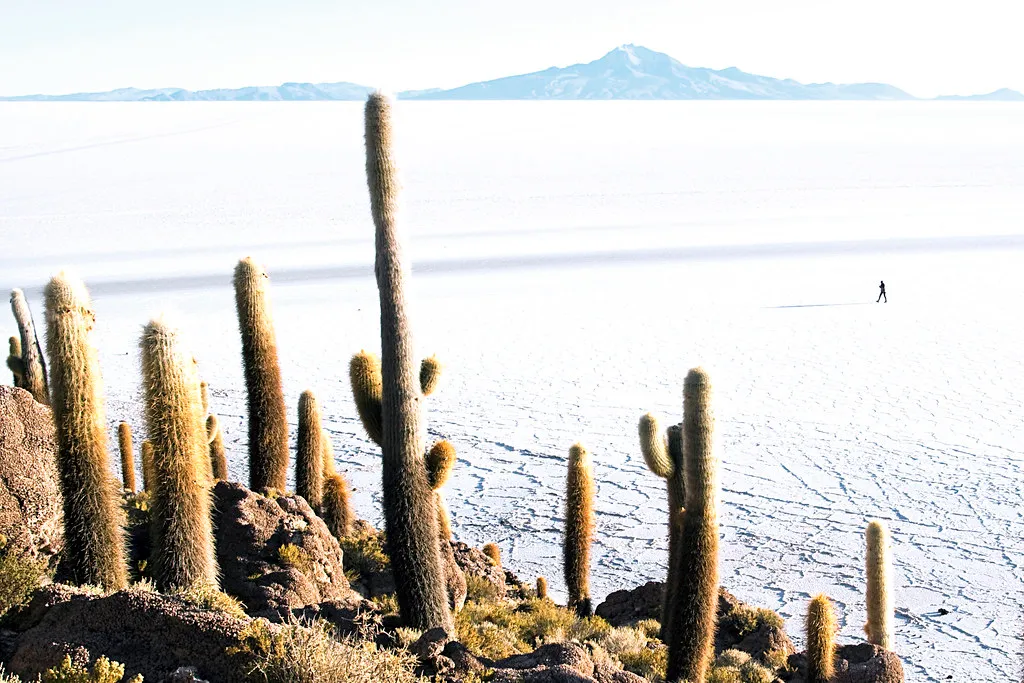
Bolivia's salt flats become a white infinity by day and a mirror of sky after rain, stretching beyond belief.
Trip fit
Is Salar de Uyuni right for your trip?
Best for
Can I realistically visit this?
Yes, with planning. A short Uyuni visit is simple, but the longer altiplano route means 4WD days, basic accommodation, cold nights, dust, altitude, and limited comfort.
Physical difficulty
Moderate (altitude, cold, basic conditions)
Planning complexity
Needs planning around 4x4 tour operators and altitude pacing
Best time to go
Best: May-Oct for dry salt. Best mirror chance: Jan-Mar. Good: Apr, Nov. Possible / transition: Dec.
Perfect for
- Photographers, road-trip travellers, big-landscape lovers, and Bolivia-Chile crossing travellers.
Not ideal if
- Travellers sensitive to altitude or those wanting comfortable hotels every night.
Compare with similar places
Salar de Uyuni vs Atacama vs Pamir Highway - high-altitude open landscapes where weather and season change the entire palette.
Location
Where this place is
Salar de Uyuni is in Bolivia / South America, useful for dramatic landscapes, photography and road trips before you choose routes, bases, and timing.
Bolivia / South America
Open location on Google Maps opens in a new tabRegional orientation only. Open Google Maps for exact location.
Travel essentials
Before you book the flight
Do you need a visa for Bolivia?
Start with the country visa-policy overview, then confirm current rules with an official source before booking.
Check visa requirements before booking
Start with the visa-policy overview, then confirm the current rules with an official embassy, consulate, or government source before booking non-refundable travel.
If using a visa service, compare processing times, fees, refund rules, and whether they cover your nationality.
Optional visa service comparison opens in a new tab- 1 EUR ≈ 12.05 BOB
- 1 USD ≈ 10.53 BOB
- 1 GBP ≈ 14.16 BOB
Exchange Rates Updated Daily. Last updated on 19/Jul/2026.

No McDonald’s benchmark available.
Use local café / fast-food meal prices instead.
Approximate McDonald’s Big Mac® price where available. Prices vary by city, branch, tax, delivery channel, and date checked. This site is not affiliated with or endorsed by McDonald’s.
Source: Countries with McDonald's restaurants reference
No reliable McDonald's/Big Mac benchmark found; likely no official McDonald's presence
Prices Researched at May 2026
Where to stay
8+ rated stays for Salar de Uyuni
Booking.com opens with an 8+ guest-score filter for Salar de Uyuni, so you can compare current hotel photos, availability, prices, and recent traveler reviews before choosing a base.
8+ guest review score on Booking.com

Why it is beautiful
The Salar de Uyuni is 10,582 square kilometres of salt crust at 3,656 metres on the Bolivian altiplano — the world’s largest salt flat, deposited when a prehistoric lake evaporated across the high plateau. The surface is so geometrically flat that satellite altimeters use it for calibration; the polygonal salt patterns are visible from above as a perfect tessellated grid. After rain, a shallow film of water covering the crust creates a reflection so precise that sky and ground merge at the horizon and the mountains appear to float. In the dry season, the white-on-white expanse with Isla Incahuasi’s cactus columns rising from it is a different kind of extremity. The Salar is the centrepiece of a wider southwest Bolivian landscape that includes coloured volcanic lagoons, flamingos at 4,300 metres, and geysers at Sol de Mañana — one of South America’s most concentrated and surreal high-altitude environments.
10 practical tips to help you decide
These tips are designed to help you decide whether the Salar de Uyuni fits your time, budget, comfort level, and travel style.
-
For photographers, big-landscape lovers, and road-trip travellers comfortable with altitude and basic conditions — not those sensitive to altitude or expecting comfort every night. The Salar experience ranges from a simple day trip to a demanding multi-day 4WD crossing. The day-trip option is achievable for most fit travellers. The extended altiplano route (Tupiza to Uyuni, 4 days) is physically demanding at 4,000–5,000 metres and requires tolerance for rough roads, cold nights, and simple hostel accommodation.
-
January to March for the mirror reflection; May to October for dry-season white salt and reliable crossings. The mirror effect — shallow water reflecting the sky — happens after altiplano rain, typically January to March (wet season). Access is reliable and the reflections are spectacular, but tours require rubber boots and some areas may be inaccessible. The dry season (May–October) gives the classic white-desert look, clear salt polygons, and easier 4WD crossings, but no mirror effect. Choose based on the image you want.
-
Fly to La Paz (VVI) or direct to Uyuni (UYU) from La Paz; trains run between Oruro and Uyuni. Uyuni has a small domestic airport with flights from La Paz (50 minutes, Amaszonas and BoA airlines). A bus from La Paz to Uyuni takes 10–12 hours overnight. Trains run from Oruro (5 hours from La Paz) to Uyuni on select days — check current Ferroviaria Andina schedules. Bolivia no longer requires advance visas for most Western nationals: most receive a free 30-day stamp on arrival. From April 2025, US and Canadian nationals need an e-Visa — check requirements at the UK FCDO Bolivia travel advice and your own government’s advisory.
-
Two to three days for the salar and altiplano highlights; four days for the Tupiza-to-Uyuni route. A one-day salt flat trip from Uyuni covers the crust, perspective photos, Isla Incahuasi, and sunset. Two to three days on an organised tour adds the Eduardo Avaroa Andean Reserve: Laguna Colorada (red from algae, pink flamingos), Laguna Verde, Sol de Mañana geysers, and Dali Desert rock formations. The Tupiza-to-Uyuni 4WD route (4 days, starting in Tupiza) turns the salt flat into the finale of a wider altiplano journey — the more adventurous and complete experience.
-
Stay in Uyuni town as the base for standard tours; book a salt-hotel for one night for the full experience. Uyuni town has the widest range of tour operators, restaurants, and accommodation. Salt hotels (hotels built from salt blocks) exist on and near the salar — basic but memorable for one night. For the extended Tupiza-to-Uyuni route, accommodation is simple hostel-style lodges at altitude: cold, adequate, and part of the experience. Mid-range hotels in Uyuni run USD 30–70 per night.
-
The salar is affordable — tours are competitively priced and Bolivia remains cheap overall. A one-day salar tour from Uyuni runs approximately USD 20–40 per person. A two or three-day Eduardo Avaroa route runs USD 100–200 per person all-inclusive (shared 4WD, guide, accommodation, meals). The Tupiza-to-Uyuni 4-day route runs USD 150–280. Park fees for Eduardo Avaroa reserve (currently bolivianos equivalent of ~USD 15) are extra. Compare operators: quality varies significantly in vehicle maintenance and guide knowledge.
-
Acclimatise in La Paz or Sucre before the salar — altitude sickness is a serious risk at 3,650+ metres. The Salar sits at 3,656 metres; the Eduardo Avaroa reserve route reaches 5,000+ metres at some passes. Altitude sickness (AMS) can affect anyone regardless of fitness. Spend two nights in La Paz (3,640 m) before heading to Uyuni. Carry acetazolamide (Diamox) after consulting your GP. Symptoms: persistent headache, nausea, dizziness, shortness of breath at rest. The UK FCDO Bolivia travel advice notes altitude as a significant health risk.
-
Book a 4WD tour operator in Uyuni directly — research carefully, as quality varies. All salar and altiplano tours depart from Uyuni in shared 4WD vehicles (typically Land Cruisers, 6 passengers). Ask operators specifically about vehicle age and maintenance, guide experience, and whether fees include Eduardo Avaroa park entry. Red Planet Expeditions, Salty Desert Aventures, and Cordillera Traveller are frequently recommended; book based on current reviews rather than historical recommendations. Avoid lowest-price operators with poorly maintained vehicles — breakdowns at 5,000 metres are serious.
-
For the mirror effect, ask operators specifically about current water levels before booking. The mirror reflection is weather-dependent and varies by year. A thin film of water (2–10 cm) gives the best results; too deep and the crust is inaccessible, too dry and there is no reflection. Contact Uyuni operators 1–2 weeks before your planned dates for a current report. Cloudy days reduce the reflection dramatically — the best mirror shots happen in morning calm before afternoon wind arrives.
-
Combine the salar with San Pedro de Atacama in Chile for a high-altitude trans-Andean circuit. The Eduardo Avaroa route typically ends at Laguna Verde near the Chilean border, from which a transfer continues 1.5 hours into San Pedro de Atacama (2,438 m, Chile). San Pedro adds the Valle de la Luna, Atacama salt flat, and the Tatio geysers in a contrasting but equally dramatic desert landscape. This Bolivia–Chile crossing is one of South America’s classic overland routes and can be completed as a single organised tour from Uyuni.